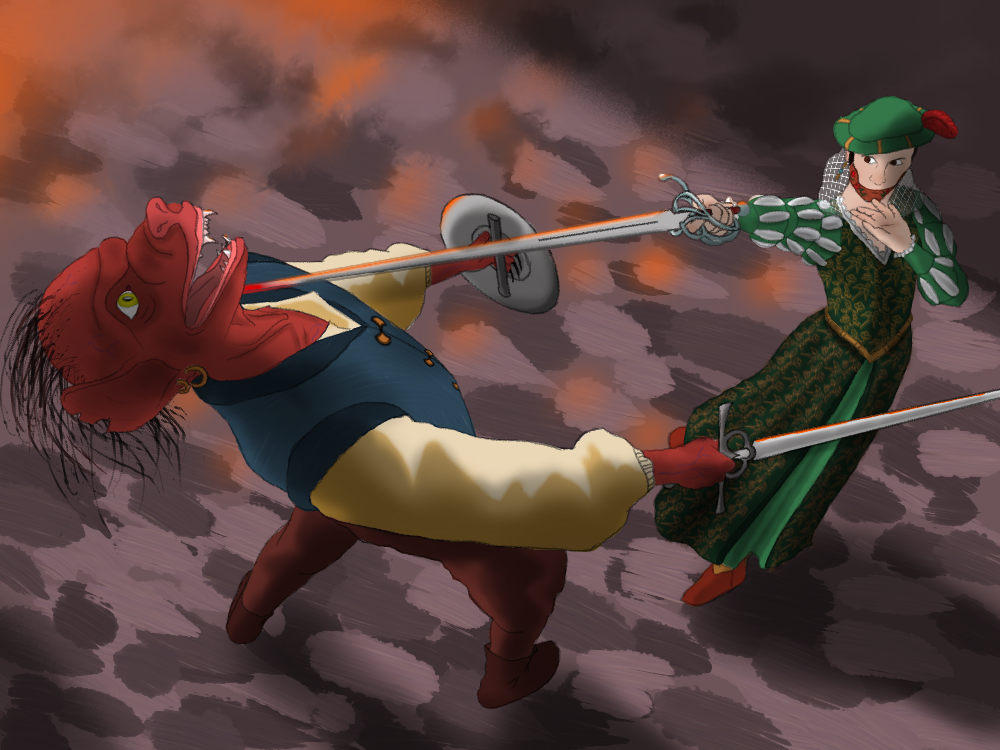
How far would you go for a miracle?
When Isabel learns the truth of the mysterious maestros who rule her city, she must learn what it means to do good from an unlikely ally.
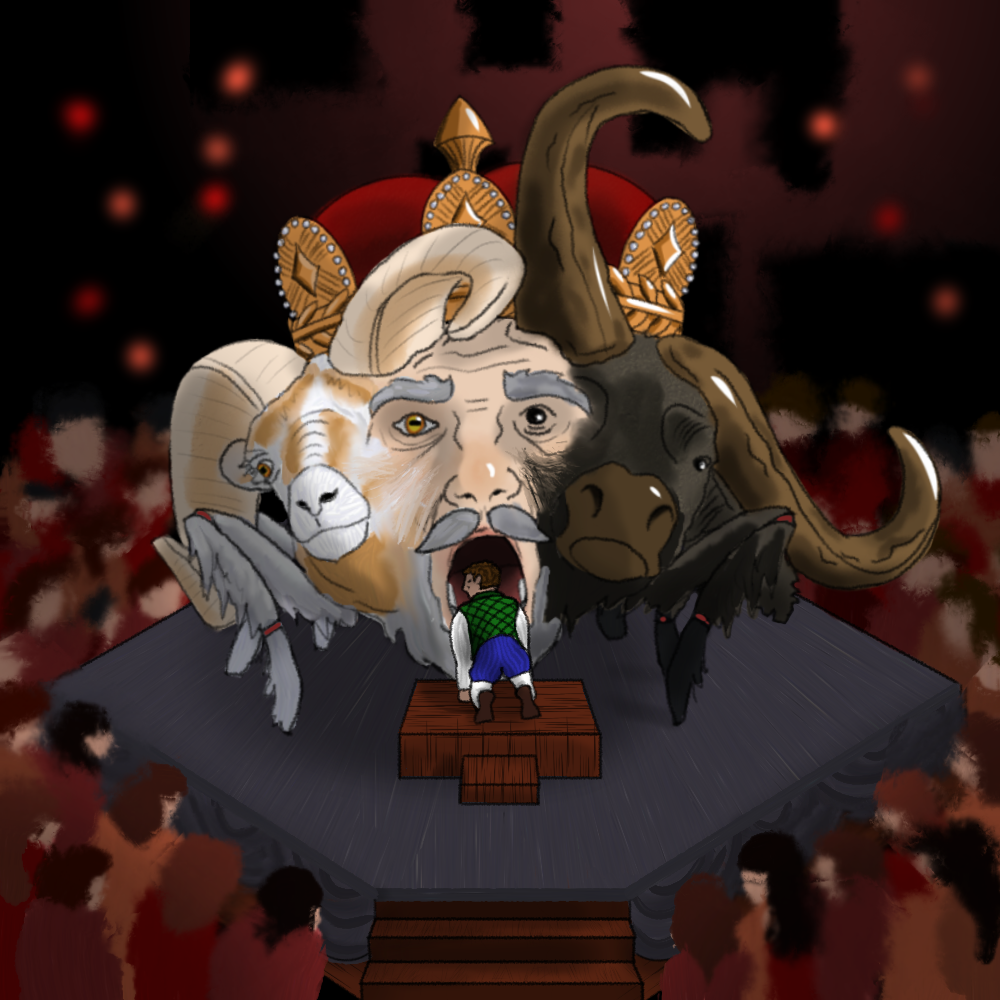
The Prayer Lottery was a rare instance of the setting manifesting in my mind before the plot. A city so densely packed and layered so high that most residents can't see the sun... A religion that's evil not because it's overbearing, but because it offers easy answers that are ultimately unsatisfying... Who might live in such a place? How do they learn what it really is? And what do they do next? All that came together to form what can be best described as "Existentialist Zorro."
Status: Writing
Sample
Chapter 1
Isabel knelt in front of the pit as prayers echoed through the chapel. <<Holy Daybringer, grant my plea,>> she signed, holding up a gold coin before dropping it over the railing. The ducat spun in the air, its sun face icon glinting in the candlelight. Then it hit the pile of identical coins at the bottom of the pit, bounced once, and came to a rest.
She looked up at the other petitioners kneeling around the pit. At her side was her faithful handmaiden Marta, dressed as she was in a plain white frock. The others she didn’t know. Most just came in to offer up one or two prayers before leaving, but several had stayed for longer. By chance she locked eyes with a balding man who wore a partly-undone ruff. He had been here at least as long as her, and his eyes shone with unshed tears. Holding Isabel’s gaze, he breathed a prayer into a ducat and let it fall.
What was his prayer, she wondered. Was he a failing merchant, using the last of his gold to pray for riches? Was he dying, and hoping to stave off the mystery for a little longer? Or was his prayer for someone else?
Who was to say that his prayer wasn’t as worthy as hers?
Isabel pursed her lips and shoved back the thought. She wasn’t backing out now, not after everything that had happened. <<Holy Daybringer, grant my plea,>> she repeated, and threw another coin into the pit.
#
Isabel bought a prayer whenever she visited her parents at the cathedral, and today was no exception. She strolled into the chapel in her best dress, signed the invocation without even fully kneeling, and rose to leave before the coin hit the pile.
Marta, her personal maidservant or duenna, was waiting for her in the arched doorway, wearing Isabel’s sword on her side. Today, Isabel’s guitar was slung across her back as well. The blessing of the maestros had given Marta a batlike head with six glossy black eyes, eyes which Isabel could see herself in as she approached.
<<Do you want to pray?>> Isabel signed.
Marta smiled and shook her head. “No, thank you. It’s not my style anymore.”
<<No?>>
“I used to pray all the time,” Marta explained, when they entered the hall and the murmur of supplicants faded away. “But once, when kneeling at the rail, I saw a beggar come in and buy a prayer, dressed all in rags. I thought it foolish: after all, he could’ve bought a new shirt or a few hot meals with that ducat. Then I got to thinking of all the other things I could do with one.”
<<But if you win…>>
“Oh, I won’t deny that there are things I could wish for, but how many prayers are offered in each chapel? And how many chapels are dotted across Santa Muerte? I’m no mathematician, but those numbers don’t look promising.”
Isabel cocked her head. In all the time Marta had been her duenna, she had never expressed any views that were less than orthodox. Irreligion wasn’t against the law—it wasn’t even a social faux pas, really—Isabel had just thought she was wiser than that.
“That’s not to say that I’m an unbeliever,” Marta added, reading her ward’s face. “Never fear, my soul is bound for Sanctum. But while I’m puttering around down here, I like to keep my treasure where I can see it. So, what did you pray for, señorita?”
Isabel looked up at the vaulted ceiling and shrugged. <<A house on La Cumbre.>>
Marta smiled. “Mmm. Where we can see the sky.”
They entered the nave, awash with the enchanted glow of the stained glass windows, each depicting an event in the Great War. Curtseying before the gold-painted statue of the Daybringer, the two women made their way along the ambulatory.
A loud complaint made them turn around. A man who’d been blessed with a clawed right hand had just entered the church, dragging his young son behind him. The boy was straining to escape his father’s grasp, exclaiming “I want to see the fight!” in a voice that echoed all through the sanctuary. The man gave him a rough cuff on the ear with his human hand and the boy’s complaints died to a whimper.
“A fight’s broken out again?” Marta groaned. “If it’s not cultists or rebels, it’s gangs. We should’ve gone to church in Babilonia.”
Isabel shook her head. <<It’s too crowded there.>>
“Mm, true enough.”
They slipped through a narrow doorway into a small dark room. A priest sat in the center on an ornate wooden chair, holding a single candle– the room’s only source of light. He nodded to her as she entered. “Welcome to Sanctum, doña Isabel. How are you today?”
“I am well, thank you,” Marta interpreted.
Isabel opened the locket hanging around her neck and offered it to the priest. Inside, pressed against the protective glass, was woven a complex knot of hairs. Most were the same chestnut color as her own, but a few were a lighter hazel and some were white.
The priest accepted the locket. “Who would you like to see?”
“Just my parents. Domingo and Luzia de Carranza.”
Isabel straightened her wooden jaw as the priest muttered an invocation. He tipped the candle over a small silver bowl of water until two beads of wax dripped in, then blew it out. Darkness engulfed the room for a moment, and the temperature dropped as a pair of the hairs in the locket began to glow. Two masses of blueish light rose from the ground, coalesced into a pair of silhouettes, then became more detailed, with hands, legs, and faces, as if formed by an invisible potter.
Isabel’s parents stood before her, dressed in perfectly tended clothes—save for the stain on her father’s doublet, gained two years ago, when he and another man had run each other through over a point of honor. Her mother had died much earlier. In fact, were it not for Isabel’s missing jaw she might have been her mirror.
<<Hello, Mother. Father.>>
“Isabel,” Mother said, looking her up and down. “You’ve grown so much.”
Isabel shook her head and smiled. She’d visited them last week.
“How are things at the estate?” Father asked. “Has Don Sandro burned the place down yet?”
Isabel shrugged. <<He’s agitated about something again.>>
Father chuckled. “I swear, I don't know if he’s ever been happy. Take my advice and use the back stair whenever he’s in one of his moods.”
<<And how are you?>>
“Oh, like Cordova says, ‘I persist. What more can I ask for?’”
<<Taste? Touch? Smell?>>
“Overrated,” Father said.
<<Really? You don’t miss life?>>
“This is life. ‘Earthly things crumble and fade. Only thought lasts forever.’”
<<Cordova again?>>
“Well, yes.”
Isabel frowned. <<He sounds very gloomy.>>
“Well, the man was locked up for thirty years. The first thing he did upon release was buy a bunch of grapes, then he popped one in his mouth and discovered they were sour! So he spent the rest of his days railing on the deceits of the body, and even now will tell people about how much better life is once you’re dead. Don Sandro mentioned there was an auction for one of his toenails, so you might be able to talk to him yourself. All that to say, I count myself fortunate to be where I am.”
Isabel made an exaggerated shrug and turned towards the door. <<Then I see you don’t need my gift.>>
“A gift?” Mother asked. “Oh, is this that surprise you mentioned the other day?”
Isabel wheeled back around with a grin on her face. <<Yes, I’ve been working on it for a month. I learned a food offering song.>>
“Oh! I’ve heard about them but never experienced one myself.”
“Camaron gigante,” Marta added, handing Isabel her guitar and pulling up a stool from the corner for her to sit on.
Isabel closed her eyes and tuned the instrument. Camaron gigante: a giant shrimp with dried seaweed flakes. Without a tongue, she didn’t know what the dish actually tasted like, but while hearing it performed by the great Velasco, she had gotten a brief spark, an idea, of flavor. She thought back to that performance as her fingers flew across the strings, hoping that what she’d heard was right: that a skilled musician could grant the sensations of living to the dead.
She plucked the final chord and Mother immediately started clapping. “That was marvelous, Isabel!”
“Hmm,” Father said, “I still contend that the mind–”
“Domingo!”
He raised his hands. “I jest, I jest! I could practically taste the caper sauce. Do you take orders?”
#
<<They were lying,>> Isabel signed as they left the Iglesia de la Garra Dorada. <<Maybe someone better can make them taste again, but I’m no Velasco.>>
“They don’t need you to be,” Marta said. “They just need you to be–”
Isabel waved her aside. <<Their daughter. I know all that.>>
“But..?”
She took a deep breath. The daybringer giant, or Portadia, had moved away just before they’d arrived at the church, so his distant shine engulfed the plaza in twilight. The air felt stuffy. <<Nothing. Next time I’ll do better.>>
“As you say, señorita.”
A semicircle of giant gargoyles stood around the rim of the church plaza, each guarding a coach. Most were part of the common carriage network, readily identifiable by the brightly colored hoods they wore. The Carranza gargoyle, however, wore a steel mask adorned with horns. A group of children got too close to it and it hissed them away through sharp fangs, then stood at attention as Isabel approached. It opened the door for them with a single massive claw.
Marta patted it on the head, not really minding that it gave no response. “Good boy, Toro.”
Isabel was about to sit down when she noticed the shouting. A crowd had gathered on the far end of the plaza. Two men who’d been blessed with wings were grappling overhead, with a third rising to meet them from further away.
Marta’s large ears slowly turned from one way to another. “There’s drawn steel all over the block. What is this place coming to?”
<<We’ll be fine, Marta.>>
“I know, I know. Let’s wait until this dies down, though. It sounds like a proper battle.”
<<Gargoyles are under Gran Maestro Bieuda’s protection. They wouldn’t dare.>>
Marta’s eyes narrowed. “But if the fighting’s broken into the air…”
<<Marta, I’m tired. I want to go home.>>
“...As you say, señorita.” Marta climbed in, throwing one last anxious glance behind her, and gave Toro the command. The gargoyle took its place on top of the coach and beat its leathery wings. They lifted off the ground, metal struts scraping against the stone, and the cathedral plaza shrank beneath them.
The Portadia came into view as soon as they cleared the roof line, looming over the houses around it with its face shining like the sun. Isabel shaded her eyes against the glare.
The flap of wings ceased as Toro fell into a glide, effortlessly weaving through the inverted towers hanging like stalactites from the city level above. The ground below and the ceiling above them dropped off into darkness as the air became fresh and salty. An updraft filled the gargoyle’s wings and they began to rise through the inter-level fissure.
Something briefly flew by their window– a man with four wings, holding a sword limply in one hand. He was probably trying to escape the melee. Given how much blood was pouring out of him, though, he wouldn’t last long either way. The distant report of a gun echoed through the buildings like thunder.
A moment passed, then the lightning struck.
Toro gave a sharp cry and Isabel felt a horrifying weightlessness as the coach pitched sharply to the right and began to drop. Her hands closed around the brass assist bar that ran above the door and shut her eyes tight.
She imagined Don Sandro summoning her and her parents, and wondered what she would say to them. <<Hello again! I’m back sooner than expected!>> And then Marta’s ghost would appear next to her and say “I told you, señorita.” The thought was almost funny.
Toro spread its wings again and Isabel fell back onto the seat. She dared to open her eyes and saw them gliding in a steep descent through a cobweb of zigzagging stone bridges. They’d left the fissure, hurtling through darkness towards she knew not where.
Suddenly there was a jolt, the crash of glass, and a grinding noise. The whole coach whirled on its side like a top, and Isabel didn’t know up from down. She curled into a ball and covered her head with her hands as she was thrown from wall to wall. Then the world stopped spinning. It took her a moment to realize the full implications of this. The coach had come to a halt. They weren’t falling anymore.
Isabel slowly uncurled herself, first extending a hand, then a leg, then the other hand. Nothing seemed broken. She moved each finger in turn, then pushed herself up to sitting.
“Are you all right, señorita?” Marta asked, crawling through the wreckage towards her. “Is anything broken?”
Isabel tried to nod and shake her head at the same time, realized the impossibility of answering both questions with a single gesture, and burst out laughing. Marta caught her up in a hug and peppered her face with kisses. The duenna’s bristly fur tickled Isabel’s face, causing her to laugh even harder.
When their cascade of emotions finally passed, Marta lit a lantern, opened what remained of the carriage door and the two of them climbed out. Toro lay on the street a ways off, letting out ragged breaths. Marta rushed to its side and raised her lantern to get a better look at the wound. She winced. “The ball went into his armpit and didn’t come out.”
<<It can’t be fixed?>>
“Not by us. We’ll have to find another way up.”
The gargoyle looked up at her, its ears perked up in the same manner it did when awaiting instructions. The lamplight shone in its eyes.
Marta pursed her lips. “...It’s not really an animal. It’s just a thing, I know. All the same…”
Isabel offered a hand, and Marta gratefully placed the hilt of her sword in it. She drew the blade and stabbed through the leathery hide of the gargoyle’s throat.
Marta bowed her head. “Farewell, Toro.”
Isabel wiped the blood off and took stock of her surroundings. They’d landed in the middle of a wide cobblestone street, lit only by the reddish glow of a few windows. The pavement was slick with moss, and the timbers of nearby houses looked half-rotted. The few people who walked the streets openly slowed their stride as they passed the women, and Isabel noted the weapons hanging on their belts. She felt more eyes than she saw.
“Where are we?” Marta wondered aloud.
Isabel didn’t know.